System Architecture & Implementation
PROJECT OVERVIEW
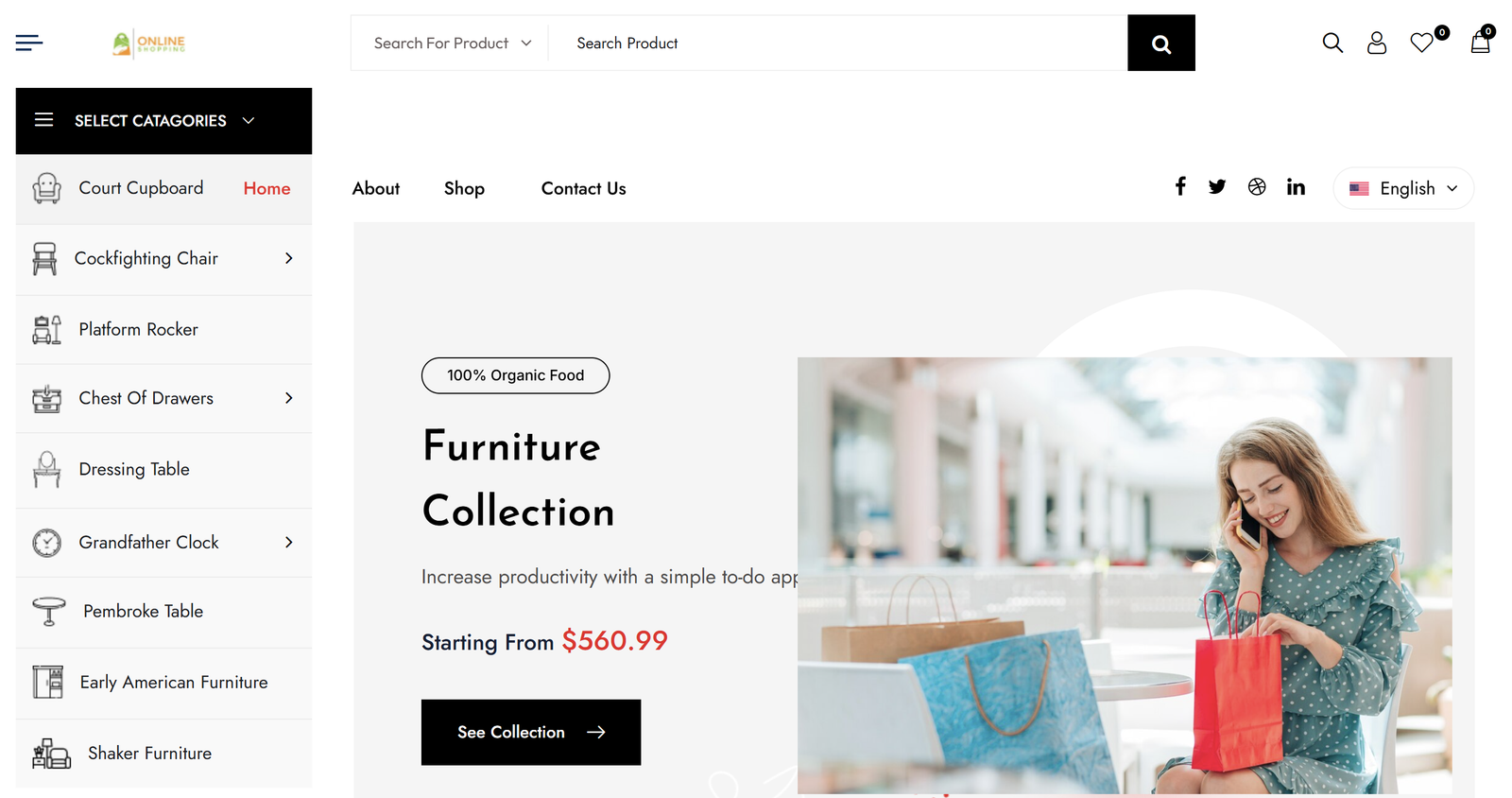
Online Shopping is a responsive e-commerce frontend web application designed to provide an engaging and user-friendly online shopping experience. The platform features product listings, promotional banners, category navigation, interactive shopping controls, and responsive layouts for desktop, tablet, and mobile devices.
CORE FEATURES
1. Responsive Product Catalog
Organized product cards, category sections, promotional banners, and multi-column layouts using CSS Flexbox and CSS Grid to maintain a consistent interface across different screen sizes.
2. Interactive Promotional Carousel
Implemented JavaScript-driven carousel functionality to display promotional banners, including the Furniture Collection, and improve visibility of featured products and offers.
3. Category-Based Product Filtering
Created tabbed product navigation for Trending, Best Seller, Music, Photography, and Sports categories, allowing users to switch between product views through interactive controls.
4. Interactive Shopping Controls
Integrated product quantity steppers, size selection options (32, 34, and 36), wishlist controls, shopping cart indicators, and off-canvas navigation menus to enhance the shopping interface.
5. Brand Showcase and Iconography
Implemented repeating brand marquees and integrated Font Awesome icons for search, user accounts, wishlist actions, shopping bags, product ratings, and social media links.
6. Responsive User Interface
Applied CSS3 styling, responsive layout techniques, hover effects, typography, discount badges, and adaptive component spacing to improve usability across screen sizes.
SYSTEM ARCHITECTURE
The application follows a client-side frontend architecture built with HTML5, CSS3, and JavaScript ES6+.
Presentation Layer:
HTML5 provides the semantic structure for navigation, product listings, category sections, promotional banners, and footer content. CSS3, Flexbox, and CSS Grid manage the visual presentation, responsive layouts, spacing, typography, and interactive hover states.
Interaction Layer:
JavaScript ES6+ manages DOM manipulation and client-side interactions, including promotional carousels, category tabs, quantity adjustments, size selection, and off-canvas menus.
Icon Layer:
Font Awesome and custom iconography provide consistent visual indicators for shopping actions, navigation, account controls, ratings, and social links.
Deployment Layer:
Netlify hosts the static frontend assets and supports continuous deployment through a connected repository, HTTPS delivery, and CDN-based content distribution.
TECHNOLOGY STACK
HTML5, CSS3, Flexbox, CSS Grid, JavaScript ES6+, DOM Manipulation, Font Awesome, Responsive Web Design, Netlify, CI/CD, HTTPS, and CDN.
ENGINEERING CHALLENGE
The primary challenge was to create a cohesive and responsive shopping interface while coordinating multiple interactive components, including promotional sliders, category-based product views, shopping controls, and navigation menus. The interface needed to remain consistent and usable across different screen sizes without compromising its visual structure.
ARCHITECTURAL SOLUTION
Implemented a structured frontend using semantic HTML, reusable CSS patterns, and JavaScript-driven interactions. Flexbox and CSS Grid provide adaptable layouts, while JavaScript controls interactive elements and updates the interface through DOM manipulation. Netlify provides the hosting and deployment infrastructure for delivering the application online.
PROJECT OUTCOME
The result is a deployed e-commerce frontend prototype that demonstrates responsive web design, interactive user interface development, product presentation, client-side functionality, and static website deployment. The project provides a foundation for potential future expansion into a full-stack e-commerce platform with backend APIs, database integration, authentication, persistent shopping carts, and payment processing.
PROJECT SCOPE
This case study describes the frontend functionality and deployment architecture. Backend services, database persistence, secure authentication, payment processing, and production order management are not claimed as implemented features.